So, I previously shared some of my code and working calculations for peak batting performance and mentioned I would be following up with some subsequent analysis off the back of this work. I would have had this out sooner, but a.) I have a day job, and b.) each call to the ESPN Cricinfo API is taking a very, very long time. But I thought given both my nationality, and with us playing well in the ICC World Cup at the moment, I would share a comparison between England Test match and ODI data; and some words of advice at how to interpret these stats.
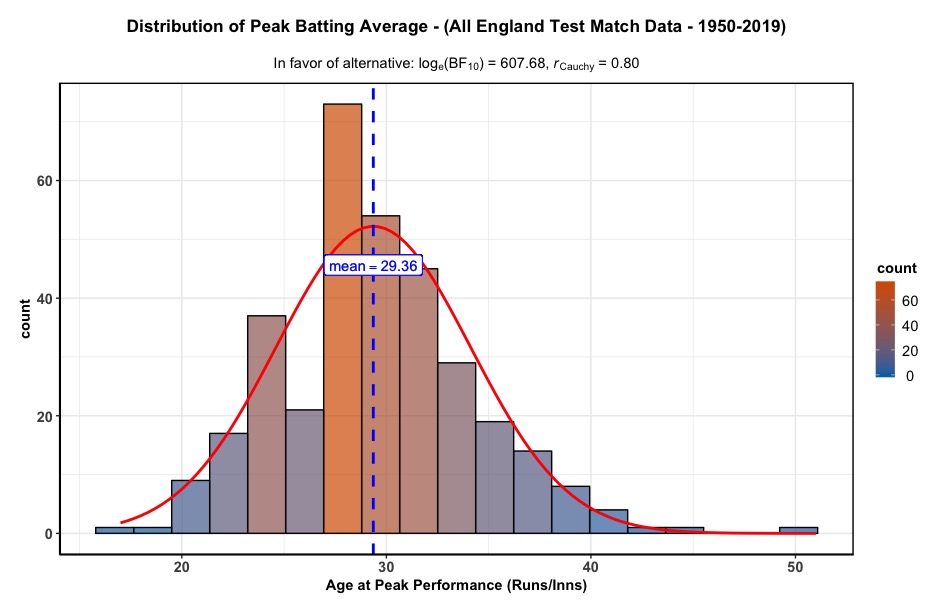
The first plot is for the distributions of age at peak performance, for all England Test match data I could call from the API. Peak performance is a metric I defined myself, and could be actually be recognised as age at peak batting average. I made this after ten individual innings per player, because there will naturally be anomalies when batters get off to absolute dynamite starts, averaging 60+ for their first ten matches; so this metric can be tweaked if anyone has a better method of defining peak batting performance.
The mean age at peak performance is 29.36, but this may or may not be the best value to go off when trying to ascertain peaks. The mean will be all of the ages within the data pool divided by the total count of data, where we want to know when most players peak, so it may be best to go off the most occurring age, which in the case of the data presented is 29. So it can be identified that the age at which most English batters peak (i.e the mode), is at 29.
When using these values, this is considerably higher than ODI cricket, where it can be seen that the age at which most English batters peak is at 25. Given the varying nature between each format of cricket, the age difference is not a surprise, although I would expect the ODI peak would be somewhat later; it may be that the inclusion criteria needs to be > 10 innings, so this can be tweaked as and when. However, it can be concluded that English batters peak later in test match cricket than in ODI; which makes sense given that test match cricket requires greater psychological aptitudes compared to ODI (which is deemed to be more of an “athletic” format).
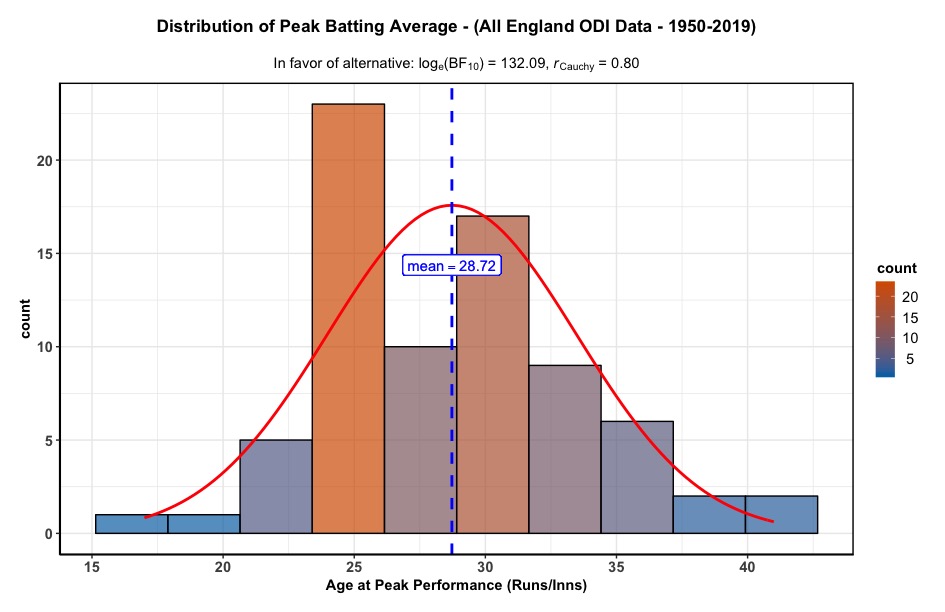
As expected both plots follow a fairly normal distribution; you would not typically expect a player’s peak batting average to be when they are either 17 or 40 years old. Furthermore, it appears that there have been far less teenage test match innings than that of the ODI format for English cricketers, which follows the typical progression that has been exemplified by the English Cricket Board throughout the years. The next progression for this series of analyses will be to pool all countries together to see if this variance between ODI and test match “peak age” is specific to England, or if it a finding that is representative of the general trends for each format. Hold tight.
 Googly Analytics